

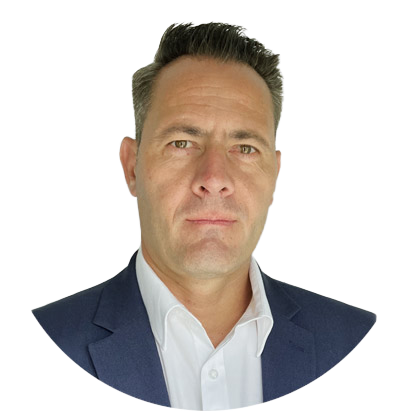
ABB’s Charl Marais on competing with Chinese rivals, investing back into Zambia and the DR Congo, and the technology shaping mining’s next decade.
By Jane Mwila Chola, Zambia Mine Safety Magazine
For ABB South Africa, the mining sector’s next chapter in Southern Africa will be won not on price, but on the strength of relationships built over decades of servicing some of the region’s toughest operating environments. That was the message from Charl Marais, ABB’s Local Division Manager for Mining and Materials and Division Manager for Process Industries, who spoke to Zambia Mine Safety Magazine on the sidelines of the Electra Mining Africa Expo 2026.
Marais painted a picture of a company with deep roots across the region but an increasingly divided operating landscape, one where Zambia remains a comparatively easy market to serve, South Africa continues to offer strong underlying demand, and the Democratic Republic of Congo has become steadily harder to navigate.
A Region of Contrasts
“In our experience, a country like Zambia has always been a good one to deal with business there has traditionally been quite straightforward,” Marais said. The DR Congo, by contrast, presents a tougher environment. “The DR Congo can be more difficult, with more regulation and less scope for direct business, although we do have a large install base in both countries,” he explained.
South Africa remains ABB’s most stable base of operations. “Business has always been reasonably easy, and I believe our product portfolio is strong and supports the mining industry well, so there is real demand for what we offer,” Marais said. But it is Zambia that ABB is now targeting for renewed investment. “We see great opportunities in Zambia in particular. We had a stronger local presence there in the past and we are looking at strengthening that again, including investing in local skills and competencies,” he added.
The DR Congo tells a different story. Marais was candid about the difficulties localisation rules have created for the company in recent years. “In the DR Congo specifically, we have been struggling more of late localisation requirements make it harder for us to bring good quality product into that market,” he said.
Servicing a Substantial Install Base
While ABB is not currently executing any large-scale projects in the region, Marais was quick to point out that the company’s footprint runs deeper than headline project wins suggest. “We have a substantial existing install base that we service includinghigh-power rectifier systems, hoisting solutions and a substantial drive- MCC, MV switchgear and other mine-related equipment across those countries,” he said.
That servicing role has not slowed ABB’s pursuit of new business. “We are actively pursuing a number of opportunities across most Southern African countries and specifically in Zambia and the DR Congo there are some good opportunities in the pipeline that we’re staying close to,” Marais noted.
Competing on Quality in a Price-Sensitive Market
Perhaps the most pointed comments of the interview concerned competition. Marais described a market increasingly shaped by lower-cost entrants from China, India and a customer base that does not always immediately grasp the trade-off between upfront price and long-term value.
“You typically find Chinese competitors active in Africa, as well as companies from India and we need to compete against them. We offer a genuinely high-quality, premium product and it can be hard to convey those advantages to customers who are very price-sensitive and focused mainly on cost.” Charl Marais, ABB South Africa
For Marais, the payoff for holding the line on quality comes later in the relationship. “When we do succeed in selling our solutions, we build long-lasting relationships, because customers experience the value proposition first-hand and develop a much stronger desire to keep working with us. Once the product has proven itself, the customer understands why we may be a little more expensive,” he said. “I do say that probably one of the toughest challenges in Southern Africa is competitors coming into the market with cheaper products that claim to do the same job but really don’t.”
ESG, Localisation and Inclusion
Beyond product and price, Marais pointed to skills transfer as central to how ABB approaches large contracts in the region. “Whenever we do business outside South Africa and even within South Africa, when we win large projects, we try to invest back into those countries by developing local skills and using as much local support as possible, transferring knowledge along the way,” he said.
That approach, he explained, is driven as much by practicality as by principle. “We understand that once a project is complete, our own team returns to base, so it’s essential that local people are equipped to support the customer through the entire product lifecycle. Investing in the social environment is always important to us,” Marais said.
On the environmental side, Marais linked ABB’s sustainability commitments directly to its product design philosophy. “From a sustainability perspective, that’s core to our product development too, we always aim for the highest efficiency and optimised production, so customers make the most of the resources they use. Our ‘Engineer to Zero’ approach to cleaner operations speaks directly to doing more with less and supporting customers in their own environmental sustainability ambitions,” he said.
A Positive Outlook for the Region
Despite the DRC’s regulatory headwinds, Marais struck an optimistic tone on the broader outlook for Southern African mining. “We are very positive about the opportunities across Southern Africa in particular. We believe ABB has a large role to play in supporting customers in the region to grow and achieve their own mandates,” he said.
He framed that opportunity in global terms, tying the region’s mineral wealth to the demands of the energy transition. “The world needs critical minerals and Africa has them in abundance, so we see it as our responsibility to help the market meet that global demand and secure the minerals needed for the clean energy transition . Overall, we are very positive about the market and the opportunities ahead,” Marais said.
Digitisation and the Road to 2027
Looking further ahead, Marais said the bulk of ABB’s investment continues to flow into upgrading its existing technology base rather than chasing entirely new product lines. Chief among these is the next generation of the company’s flagship control system. “From an automation standpoint, we have just launched the next generationof our world-leading digital control system, the ABB Ability 800xA called Automation Extended. We see that as the platform that enables customers to digitise and transform their operations,” he said.
Marais described the 800xA platform as the foundation for a broader digital push across ABB’s mining customers. “It underpins all the digital solutions we offer, helping customers become truly optimised in their approach to mining and make more informed decisions through better data availability,” he said, adding that energy optimisation is fast becoming a competitive differentiator in its own right. “That’s also a key focus for driving sustainability: the ability to optimise energy use based on what’s available from renewables, grid connections, batteries or other source, is a huge competitive advantage for our customers.”
On the mechanical side, Marais pointed to continued investment in safety and reliability as mines are forced deeper in search of remaining reserves. “As the world becomes more competitive and resources run deeper, we are investing heavily in mine hoist systems and improving hoisting safety, as well as in our grinding solutions including gearless mill drives. The large grinding equipmnet we supply, focus on robustness ,maximising availability and energy efficieny since that’s typically a bottleneck in any processing plant,” he said.
He closed by pointing to local beneficiation, rather than extraction alone as the area where ABB believes it can add the most lasting value to African economies. “We are also focused on supporting our regional customers in beneficiating more locally, rather than simply mining and shipping ore to other locations – that’s where we believe we can bring the greatest value and investment into the African market,” Marais said.
